

🇯🇵 Inside a Japanese Home(にほんのいえ): Learn Japanese Through Everyday Life
- Sora Sensee

- 23 hours ago
- 5 min read
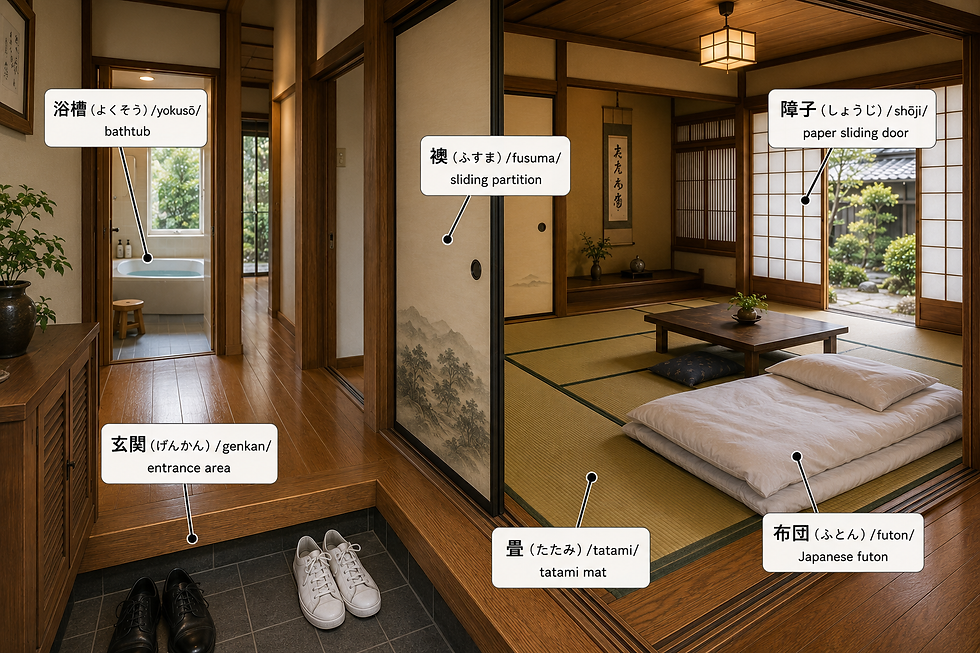
Ever wondered what it's like inside a Japanese home? Discover Japanese customs, useful vocabulary, cultural insights, and everyday expressions while exploring the genkan, tatami rooms, futons, and bathing traditions.
🏡 Welcome to a Japanese Home
Imagine you're visiting a Japanese friend's home for the first time.
As you reach the front door, they smile and say:
「どうぞ、お入りください。」Dōzo, ohairi kudasai."Please come in."
You step inside—then suddenly stop.
Everyone has already taken off their shoes.
Later that evening, you discover another surprise: the family shares the same bathtub.
At first, these customs might seem unusual.
But once you understand why they exist, you'll discover something much more valuable than vocabulary—you'll discover how Japanese culture shapes everyday language.
Let's step inside.
👟 Genkan (玄関・げんかん・genkan)
The genkan is the entrance area of a Japanese home.
Rather than simply being a place to leave shoes, it separates the "outside world" from the clean living space inside.
Everyone removes their outdoor shoes before entering, and guests are often offered indoor slippers.
This custom helps keep dirt, dust, and rainwater outside because people regularly sit, relax, and sometimes sleep on the floor.
💡 Did you know?
You'll also find a genkan in schools, temples, traditional inns (ryokan), clinics, and many traditional restaurants.
It isn't just part of a house—it's an important part of Japanese daily life.
🇯🇵 Culture Note
In many Western countries, wearing shoes indoors is perfectly normal.
In Japan, however, entering a home with outdoor shoes is generally considered disrespectful because it brings the outside into a shared living space.
🗣️ Useful Japanese
When entering someone's home, people usually say:
「おじゃまします。」Ojama shimasu.
Literally, it means "I'm going to disturb you."
In reality, it politely expresses appreciation for being welcomed into someone else's private space.
This is a wonderful example of how Japanese often values humility over directness.
⚠️ Common Mistake
Many learners translate 玄関 simply as "entrance."
A genkan is specifically the area where shoes are removed before entering the home.
🛁 A Bathroom Built for Relaxation
Many visitors are surprised that Japanese homes often separate the toilet from the bathroom.
Even more surprising is the bathing routine.
Before entering the bathtub, everyone carefully washes and rinses their body.
Only after becoming completely clean do they soak in the hot water.
The bathtub isn't for washing.
It's for relaxing.
Because the water remains clean, many families traditionally share the same bathwater, although modern lifestyles naturally vary from household to household.
🌿 Culture Note
The Japanese word
お風呂 (おふろ・ofuro)
doesn't only mean "bath."
It often refers to the entire relaxing bathing experience.
For many Japanese people, taking a bath is an important way to unwind after work or school.
✨ Pro Tip
If you stay with a host family, let them explain their bathing routine first.
Following the family's customs is considered good manners.
🏡 Washitsu (和室・わしつ): A Room That Changes Its Purpose
Many modern homes include Western-style rooms, but many also have at least one 和室 (わしつ)—a traditional Japanese-style room.
The floor is covered with 畳 (たたみ・tatami), traditionally made from woven rush grass.
Tatami creates a soft surface for sitting, relaxing, and sleeping.
Japanese-style rooms also use sliding doors instead of hinged ones.
Japanese | Reading | Meaning |
障子 | しょうじ | Paper sliding door |
襖 | ふすま | Sliding room partition |
💡 Did you know?
Tatami naturally helps regulate humidity and has a distinctive fresh scent that many Japanese people associate with comfort and home.
This is one reason why many people still enjoy having at least one tatami room today.
🛏️ Futons: A Bedroom That Disappears
Instead of permanent beds, many families use 布団 (ふとん・futon).
At night, the futon is laid directly on the tatami floor.
In the morning, it's folded and stored inside an 押し入れ (おしいれ・oshiire) closet.
The same room can then become a study, living room, playroom, or guest room.
📦 Why is this important?
Traditional Japanese homes were designed to make efficient use of limited space.
Rather than giving every activity its own room, one room could serve many different purposes throughout the day.
This flexible way of living continues to influence Japanese homes today.
👣 One House Rule Every Visitor Should Remember
If you're wearing indoor slippers, never walk onto tatami with them.
Instead, remove your slippers before stepping onto the mats.
Tatami isn't just flooring.
It's a clean living surface where people often sit, sleep, and spend time with family.
Following this small custom shows respect for your host.
🇯🇵 Learn Japanese Through Culture
One of the best ways to remember vocabulary is to connect it with real life.
Imagine visiting a Japanese friend's home:
🚪 おじゃまします。 — when entering.
👋 ただいま。 — when returning home.
😊 おかえり。 — when welcoming someone back.
These expressions appear in everyday conversations, anime, dramas, and real homes across Japan.
Learning the culture behind them makes them much easier to remember than memorizing translations alone.
🧠 Learning Tip
Language and culture are deeply connected.
Instead of asking, "What does this word mean?"
Try asking,
"Why do Japanese people say this here?"
That question often leads to a much deeper understanding of both the language and the people who speak it.
🌸 What Japanese Homes Teach Us
Japanese homes quietly reflect values found throughout Japanese society.
Value | How It Appears at Home |
🧹 Cleanliness | Shoes stay in the genkan. |
🤝 Consideration | Shared bathwater stays clean for everyone. |
🌿 Harmony | Calm, uncluttered living spaces. |
📦 Efficiency | One room serves many purposes. |
💚 Respect | Simple daily routines show consideration for others. |
🎯 Takeaway
When you learn about Japanese homes, you're learning much more than architecture.
You're discovering how culture shapes everyday language, manners, and communication.
That's what makes studying Japanese so rewarding.
References
Japan National Tourism Organization (JNTO). Japanese Manners & Etiquette.
Japan National Tourism Organization (JNTO). Staying at a Ryokan.
Agency for Cultural Affairs, Government of Japan.
NHK WORLD-JAPAN.
Kodansha. Japan: An Illustrated Encyclopedia.
Key Vocabulary
Japanese | Reading | Meaning |
玄関 | げんかん /genkan/ | Entrance area |
おじゃまします | おじゃまします /ojamashimasu/ | Excuse me for intruding |
お風呂 | おふろ /ofuro/ | Bath / bathing |
浴槽 | よくそう /yokusoo/ | Bathtub |
和室 | わしつ /washitsu/ | Japanese-style room |
畳 | たたみ /tatami/ | Tatami mat |
障子 | しょうじ /shooji/ | Paper sliding door |
襖 | ふすま /fusuma/ | Sliding partition |
布団 | ふとん /futon/ | Futon |
押し入れ | おしいれ /oshiire/ | Futon closet |
ただいま | ただいま /tadaima/ | I'm home |
おかえり | おかえり /okaeri/ | Welcome home |
Continue Your Japanese Journey 🇯🇵
Thank you for reading!
If you found this article helpful and would like personalized guidance, I'm always happy to answer lesson inquiries and help you build a Japanese study plan that fits your goals.
Whether you're preparing for the JLPT, planning a trip to Japan, or simply want to speak Japanese more naturally, I'd love to help.
You can find my lesson inquiries, articles, learning resources, and social media here:
Thank you for reading, and I'll see you in the next article!


Comments